Reading-Notes
Stacks:
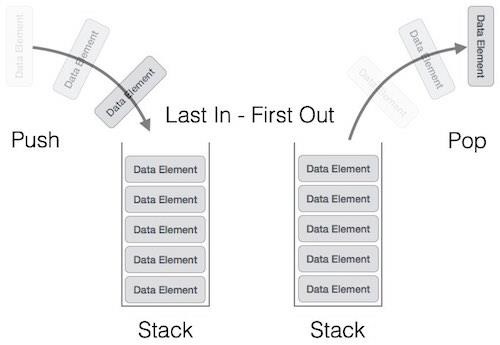
Data structure consists of nodes each node reference to next node in the stack but does snot reference its previous .
- the most important part of a stack: the (Top) attribute/pointer always pointing of the last element/node added to the stack _______
One of the most common methods for stack are: push and pop in linked lists i can insert or delete any of the nodes, but in stacks I only can edit the node that the (top) is pointing on (the first node) — that makes it always give me a time complexity of O(1) _______
Push creteria:
Top pointer will point on the top of the node.
-create a node (3)
- make the next of new node to be the value of ehat the pointer top is referring to (None)
- make the top pointer refer to the new node
pushing another one: -create naother node(5)
- make the next of it equal the value of top pointer referring to (fisrt node)
- make the top refer to the new node
5 -> 3 -> None —> Top is pointing to (5)
______
class Node:
    def __init__(self, value):
        self.value  = value
        self.next = None
class Stack:
    def __init__(self, node = None):
        self.top = node    --> always refers to a node, that will start with None

    def push(self, value):
        node = Node(value)  ---> creating a node
        node.next = self.top ---> making the next equal what top is referring to
        self.top = node ---> changing pointer top to be on the new value
testing:
import your python file

def test_push():
    stack = Stack()
    stack.push(5)
    stack.push(3)
    stack.push(2)

actual = stack.top.value
expexted = 2
assert actual == expected
Pop method:
-create a temp pointer to refer on the top/first node
- change the top pointer to refer to the previous one
- change the next of the to temp(fisrst node) and make it refer to None
    ...
    def pop(self): ---> with no values because its always popping the frist node

        temp = self.top ---> create  a new pointer to take the top place

        self.top = self.top.next ---> changing the top to be referring to the second node

        temp.next = None  --> disconnected the node from the stack

        return temp
tests:
def tes_pop():
    stack = Stack()
    stack.push(5)
    stack.push(3)
    stack.push(2)

    actual = stack.pop() ---> because in the method i am returning temp which is the popped value
    expected = 2
    assert actual == expeted
FILO–> fist in last out
peek –> will return the top value of the stack
    def peek(self):
        return self.top.value
    def is_empty(slelf):
"""
checks weather the stack is empty -- returns true if its empty
"""
        return self.top == None ---> if i have a value for top it will give me true
def test_peek():
    stack = Stack()  --> [2,3,5]
    stack.push(5)
    stack.push(3)
    stack.push(2)

assert 2 == stack.peek()
def test_is_empty():
    stack = Stack()

assert True == stack.is_empty()
we can use fixtures for the repeated ( stack = Stack() stack.push(5) stack.push(3) stack.push(2) )
-imoprt pytest first
@pytest.fixtures
def stack():

    s = Stack()
    stack.push(5)
    stack.push(3)
    stack.push(2)

    return s    ----->> now we can replace the above in each test with passing (stack)
Example:
def test_push(stack):

actual = stack.top.value
expexted = 2
assert actual == expected
Queue:
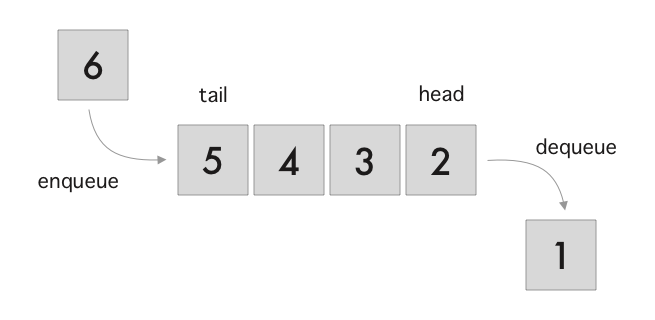
Linear data structure that contains two properties: front -> which points to the fist node in the queue rear -> points to last node in the queue
-
if a new node wants to join the queue: it will be pushed after the rear –> so the new rear is the new node.
-
the front can leave and the front will be pointed to the next node
*adding new node –> enqueue method –> happens from rear *remove a node –> dequeue method –> happens form fornt
FIFO –> first in first out
LILO –> last in last out
enqueue:
- create a node
- rear.next make it equal to new node
- change the rear value to be the new node ——
- if i have an empty queue:
when queue is None (rear and front are None):
the front AND the rear are going to point to the new node(as the first and last node)
____
class Queue:
    def __init__(self)
        self.front = None
        self.rear = None

    def enqueue(self, value):
        node = Node(value)
        if not self.front: --> if its None, empty// if self.rear:
            self.rear = node
            self.front = node

        else:
            self.rear.next = node
            self.rear = node
def test_enqueue():
    queue = Queue()  --> [5,7,9]--> [rear, .. , front]
    queue.enqueue(5)
    queue.enqueue(7)
    queue.enqueue(9)

    actual = queue.rear.value
    expected = 5
    assert actual == expected