Reading-Notes
Game of Greed 2
Python Scope & the LEGB Rule:
Scopes overview
- Determines how variables and names are looked up, or their visibility in your device.
- The scope depends of the place where a variable is created.
- The scope is presented in LEGB rule (Local, Enclosing, Global, Built-in).
- A name will only be accessible in its scope.
Scope types
- Global scopes: avalible for all code.
- Local scopes: available only within the scope.
You can create Python names through one of the following operations: [^1] |Operation |Statement | | ———– | ———– | |Assignments | x = value | |Import operations |import module/from module import name | |Function definitions |def my_func()| |Argument definitions in the context of functions |def my_func(arg1, arg2,… argN)| |Class definitions | class MyClass|
Note: There’s an important difference between assignment operations and reference or access operations. When you reference a name, you’re just retrieving its content or value. When you assign a name, you’re either creating that name or modifying it.
Python Scope vs Namespace
- Python scopes are implemented as dictionaries that map names to objects(called namespaces).
- This is the mechanism of storing names. They’re stored in a special attribute called .dict.
Using the LEGB Rule for Python Scope
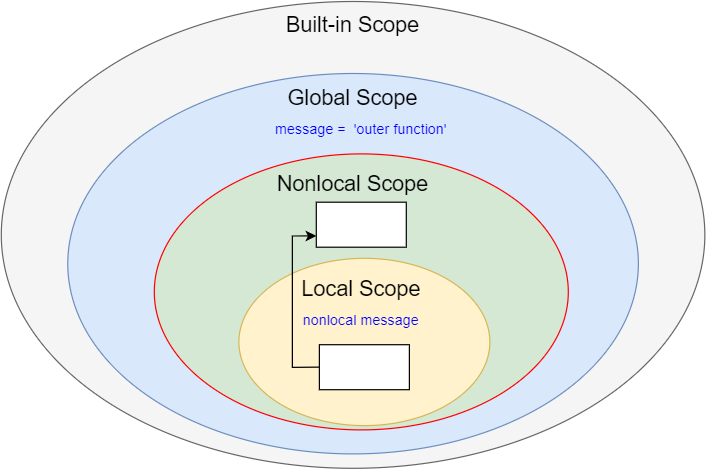
- Local scope –> is the code block or body of any Python function or lambda expression.
- Enclosing (or nonlocal) –> only exists for nested functions, The names in the enclosing scope are visible from the code of the inner and enclosing functions.
- Global (or module) –> contains all of the names that you define at the top level of a program or a module.
- Built-in scope –> This scope contains names such as keywords, functions, exceptions, and other attributes that are built into Python. names are available from everywhere in your code, aytomatically loaded whenever you run a script or a program.
The LEGB rule is a kind of name lookup procedure, which determines the order in which Python looks up names. For example, if you reference a given name, then Python will look that name up sequentially in the local, enclosing, global, and built-in scope. If the name exists, then you’ll get the first occurrence of it. Otherwise, you’ll get an error.
Differences between LEGB rules
Big O notation
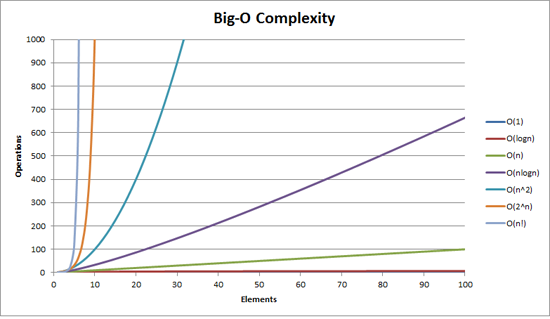
- How much time and space in memory it being consumed while an algorithm is being executed.
- It is a way to measure how the algorithm will process to increasing data in terms of time and space.
- A way of comparing different algorithm.
- Big O notation gives the worst case senario.
- Computational complexity:
- O(1) : constant running time.
- O(n) : linear running time.
- O(n^k): polynomial running time.
- O(log n): logathimic running time.
- O(n log n): log-linear running time.
More [^1]:https://realpython.com/python-scope-legb-rule/